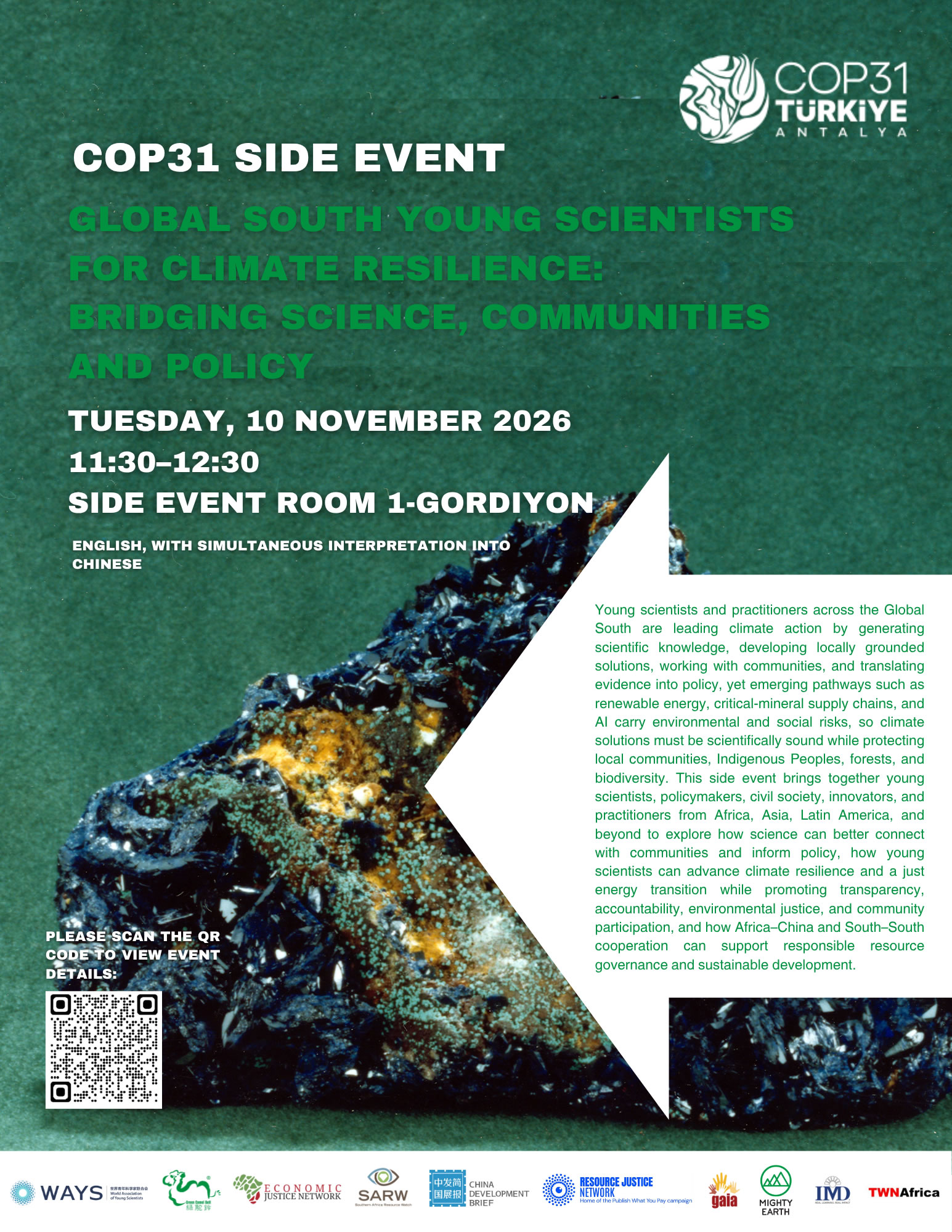
UNFCCC COP31 opens soon in Antalya, Türkiye. The host has framed this summit as the “implementation COP”in which climate action must move beyond negotiating texts into policy, finance, and communities. On 10 November, the thematic day is Energy and Transport. That same day, a side event co-hosted by a group of Global South organizations will take up a question that is too often folded out of the energy transition story: where do critical minerals come from, who bears the costs, and what role do science and communities play?
A Side Event on the “Other Side” of the Transition
The energy transition needs lithium, cobalt, nickel and copper. These minerals are concentrated in the Global South, while ecological and social risks from extraction and processing are mounting fast. Business & Human Rights Resource Centre recorded a 73% increase in human rights abuses linked to transition minerals between 2024 and 2025. More than half of critical mineral projects are located on or near Indigenous lands, and community protests have repeatedly disrupted production. Environmental data at the mine level remains deeply opaque, leaving communities and downstream companies unable to monitor effectively. This is not a footnote to be waved away in the “zero-carbon future” narrative. It is a key test of whether climate action can be just and sustainable.
Young Scientists at the Fault Lines
Young scientists and practitioners across the Global South are doing several things at once: producing scientific knowledge on mining impacts and climate resilience, developing technologies suited to local conditions, working directly with communities, and trying to translate evidence into policy language. But they face a structural problem: scientific evidence often lags behind the pace of extraction; community voices often never reach the rooms where supply-chain governance is decided; and policy frameworks often sidestep rights safeguards in the name of “investment facilitation.”
This side event aims to bring these threads into one conversation. The theme is “Global South Young Scientists for Climate Resilience: Bridging Science, Communities and Policy.” The key word is not the label “youth” , but connection: how science can avoid becoming after-the-fact justification, how communities can avoid becoming a box on a stakeholder list, and how policy can genuinely respond to frontline evidence.
Two Panels, One Throughline
The side event features two practitioner panels, both organized around the same question: in a critical-mineral-driven energy transition, is justice a precondition or an afterthought?
The first panel focuses on climate resilience, critical minerals, and communities. Panelists from Resource Justice Network, Mighty Earth, GAIA and PWYP Indonesia will speak from perspectives including resource justice, supply-chain transparency, zero-waste approaches to mining, and mineral traceability frameworks. Aryanto Nugroho has long worked in Indonesia on extractive transparency and mineral supply-chain accountability; his work touches a core contradiction: demand for green technologies is soaring, while the gap between permitting speed and community rights safeguards is widening.
The second panel turns to Africa–China cooperation and responsible mining. Southern Africa Resource Watch (SARW) will bring the perspective of the Africa Mining Accountability Platform; Professor Sun Yongping of Huazhong University of Science and Technology will respond from the angle of South–South cooperation mechanisms and green technology transfer; and a national climate coordinator from Africa will bring field experience on adaptation and just transition. The discussion will not shy away from disagreement, nor will it assume that “cooperation” automatically equals justice.
Why Attend
This session speaks directly to COP31’s implementation agenda. It connects critical mineral governance, community evidence and supply-chain accountability—issues too often discussed in separate rooms—and asks what transparency, participation and South–South cooperation should look like in practice. Participants will hear from practitioners working on traceability, zero-waste mining and community rights, and leave with a clearer sense of where policy action and practical opportunities lie. If you work on climate policy, resource governance or community rights, bring your questions.
Frontline evidence belongs in the policy room.
Time: Tuesday, 10 November 2026, 11:30–12:30
Venue: Side Event Room 1 – GORDIYON, COP31, Antalya, Türkiye
Language: English, with Chinese interpretation