

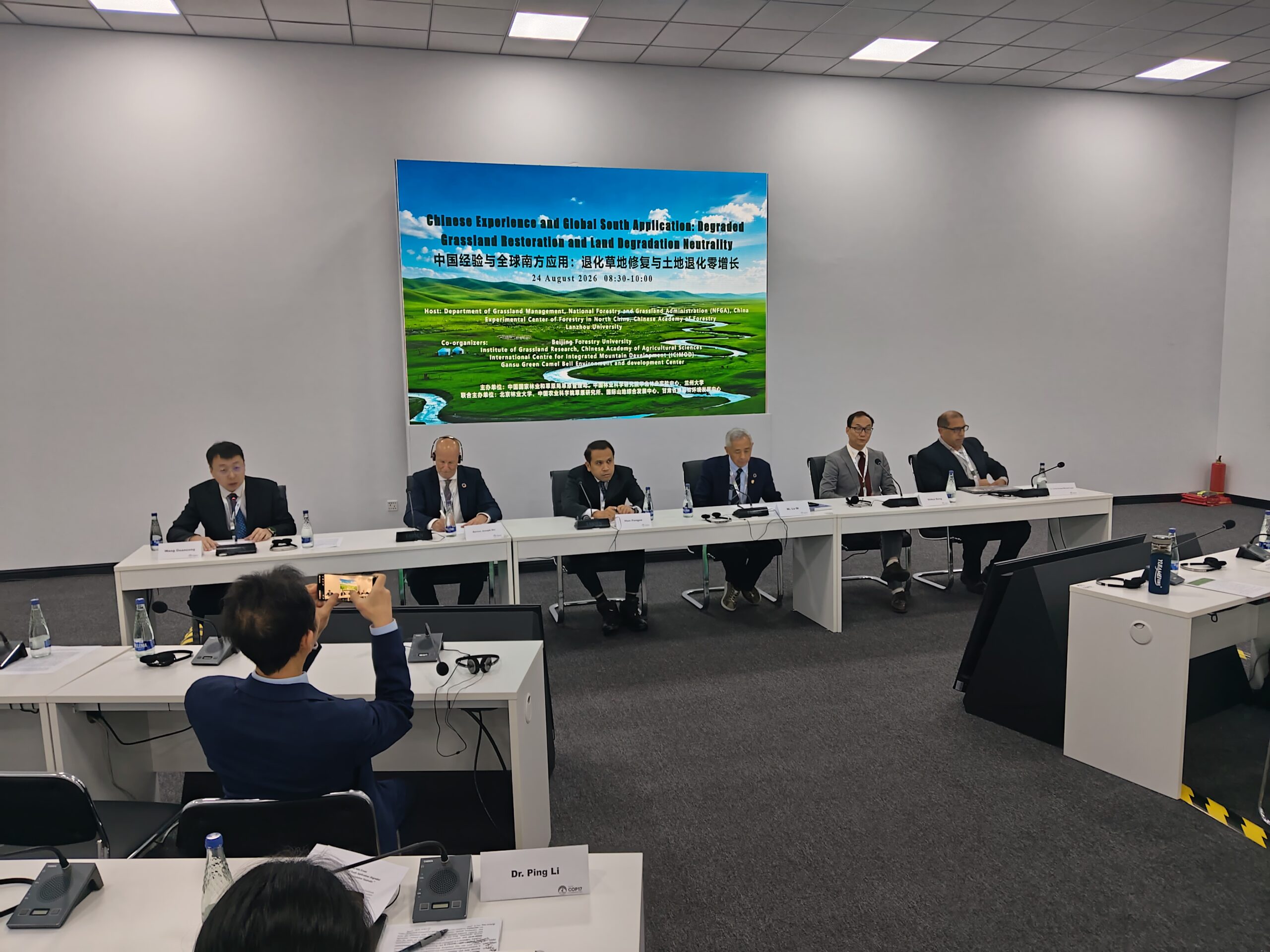
On 24 August, the side event “Chinese Experience and Global South Applications: Degraded Rangeland Restoration and Land Degradation Neutrality” was held in Ulaanbaatar, Mongolia, on the sidelines of the seventeenth session of the Conference of the Parties to the United Nations Convention to Combat Desertification (UNCCD COP17).
The event brought together representatives from China and Mongolia, the UNCCD secretariat, the International Centre for Integrated Mountain Development (ICIMOD), universities and research institutions, ecological restoration companies and pastoralist communities. Discussions focused on degraded rangeland restoration, Land Degradation Neutrality (LDN), cooperation across the Global South and follow-up action to the International Year of Rangelands and Pastoralists (IYRP), including a proposal to establish an International Rangeland Day.
The side event was hosted by the Grassland Management Department of China’s National Forestry and Grassland Administration, the Experimental Center of Forestry in North China of the Chinese Academy of Forestry, and Lanzhou University. Co-hosts included Beijing Forestry University, the Institute of Grassland Research of the Chinese Academy of Agricultural Sciences, ICIMOD and the Gansu Green Camel Bell Environment and Development Center.
Building Consensus for Global Rangeland Conservation
The United Nations designated 2026 as the International Year of Rangelands and Pastoralists. Rangelands cover around half of the world’s land surface and play a vital role in supporting biodiversity and pastoral livelihoods. Against the backdrop of climate change and land degradation, restoring degraded rangelands, strengthening ecosystem resilience and supporting sustainable pastoral livelihoods have become increasingly important global priorities.
In his opening remarks, Mr. Han Fengze, Deputy Director General of the Grassland Management Department of the National Forestry and Grassland Administration, stressed that land degradation knows no borders and that rangeland conservation requires international cooperation.
He noted that countries across the Global South are home to extensive natural rangelands, but share challenges related to land degradation, pastoral livelihoods, finance, technology and capacity. Greater policy dialogue, scientific and technological cooperation and exchange of experience are therefore essential.
Han said China has long pursued integrated conservation and systematic governance across mountains, rivers, forests, farmland, lakes, grasslands and deserts, while continuing to restore degraded rangelands and explore ways to balance ecological conservation with pastoral development.
He also put forward four proposals: jointly advancing an International Rangeland Day; giving rangelands greater prominence in global land governance; strengthening rangeland governance through scientific and technological innovation; and deepening cooperation across the Global South.
Mr. Lu Qi, Counsellor of the State Council of China and a UN Champions of the Earth laureate, said rangeland issues should be considered within the broader framework of global land governance, desertification control, food security and pastoral livelihoods.
He called for joint efforts to “restore vitality to rangelands, make conservation a livelihood for pastoralists, enable pastoralists to share the benefits, and share ecological gains with the world.”
Dr. Barron Joseph Orr, Chief Scientist of the UNCCD, stressed the need to strengthen coordination among science, policy and communities, while balancing ecological, economic and social needs. He noted that China’s experience in coordinating environmental protection, economic development and social needs across large landscapes and regions could offer useful lessons for land protection and restoration elsewhere.
Sharing Chinese Practices and Exploring Restoration Pathways
During the keynote session, Mr. Wang Guancong, Director at the Grassland Management Department of the National Forestry and Grassland Administration, presented China’s experience in rangeland conservation, restoration and sustainable development.
During China’s 14th Five-Year Plan period, nearly RMB 200 billion was invested in the rangeland sector. More than 46 million mu of rangeland were restored each year, while healthy and sub-healthy rangelands reached 2.7 billion mu, accounting for more than 70 percent of the country’s grassland area.
Wang said China has followed the principles of conservation first, systematic restoration and science-based use, combining institutional protection, ecological restoration and grass-livestock balance while exploring green development models including the grass seed industry and ecological pastoralism.
Dr. Carlos Enrique Michaud, Co-Chair of the Global Alliance for Rangelands and Pastoralists, reviewed the development of the International Year of Rangelands and Pastoralists. He said the initiative should go beyond awareness-raising to support policy improvements, knowledge exchange and sustained investment, while giving pastoralists a stronger voice in international policy processes.
He also welcomed China’s proposal for an International Rangeland Day as a way to sustain the momentum generated by IYRP 2026.
Dr. Yuan Weijie of the Experimental Center of Forestry in North China, Chinese Academy of Forestry, discussed pathways for degraded rangeland restoration from a Global South perspective.
She emphasized that restoration should not focus solely on vegetation recovery, but should also address ecological processes, biodiversity, soil quality, pastoral incomes and policy support. She also shared China’s grassland-photovoltaic complementary model, which combines photovoltaic power generation, rangeland restoration and pastoral production to explore synergies between ecological recovery and local economic development.
Ms. Hindou Oumarou Ibrahim, President of the Association of Indigenous Women and Peoples of Chad (AFPAT), shared community-based practices that combine satellite imagery, participatory mapping and Indigenous knowledge in land restoration.
She stressed that science, technology and Indigenous knowledge can reinforce one another, and called for stronger South-South cooperation and greater exchange of experience among countries and communities.
Bringing Diverse Voices Together for an International Rangeland Day
A roundtable discussion titled “A Key Legacy of IYRP: Advancing an International Rangeland Day” was moderated by Jashi Dorji of ICIMOD. Representatives from research institutions, businesses, pastoralist communities and local government in Mongolia shared their perspectives.
Dr. Li Ping, a researcher at the Institute of Grassland Research of the Chinese Academy of Agricultural Sciences, said an International Rangeland Day could help raise public awareness of the value of rangelands and the importance of rangeland science. She said it could also facilitate transnational research networks, long-term monitoring, data exchange and training for young researchers, while contributing to international technical guidelines and standards for rangeland conservation and management.
Pastoralist representative Ms. Qiburi from Inner Mongolia emphasized that pastoralism is not aimless or disorderly migration, but a sustainable way of life shaped by generations of experience. As climate uncertainty increases, she said pastoralists need not only scientific monitoring and policy support, but also greater opportunities to participate in research and policymaking.
She described an International Rangeland Day as “not merely a symbolic observance, but a bridge for knowledge sharing and participation in decision-making,” and said it could help bring pastoral knowledge into global land governance while turning the momentum of IYRP 2026 from a one-year agenda into a longer-term institutional arrangement.
Business representatives Mr. Boerjin, General Manager of Inner Mongolia Burula Ecological Technology Co., Ltd., and Mr. Tuo Xiangyin, a representative of YuanSheng LvYang Forest and Grass Ecological Engineering Company in Ningxia, also expressed support for the proposal. They said an International Rangeland Day could raise international recognition of the ecological and social value of rangelands, encourage wider participation in degraded rangeland restoration, and strengthen collaboration among governments, research institutions, businesses and pastoralists.
Mr. Samdannyam Munkhchuluun, Governor of Dundgovi Province, Mongolia, also expressed his support for the establishment of an International Rangeland Day from a policymaker’s perspective.
Shape the Future Together
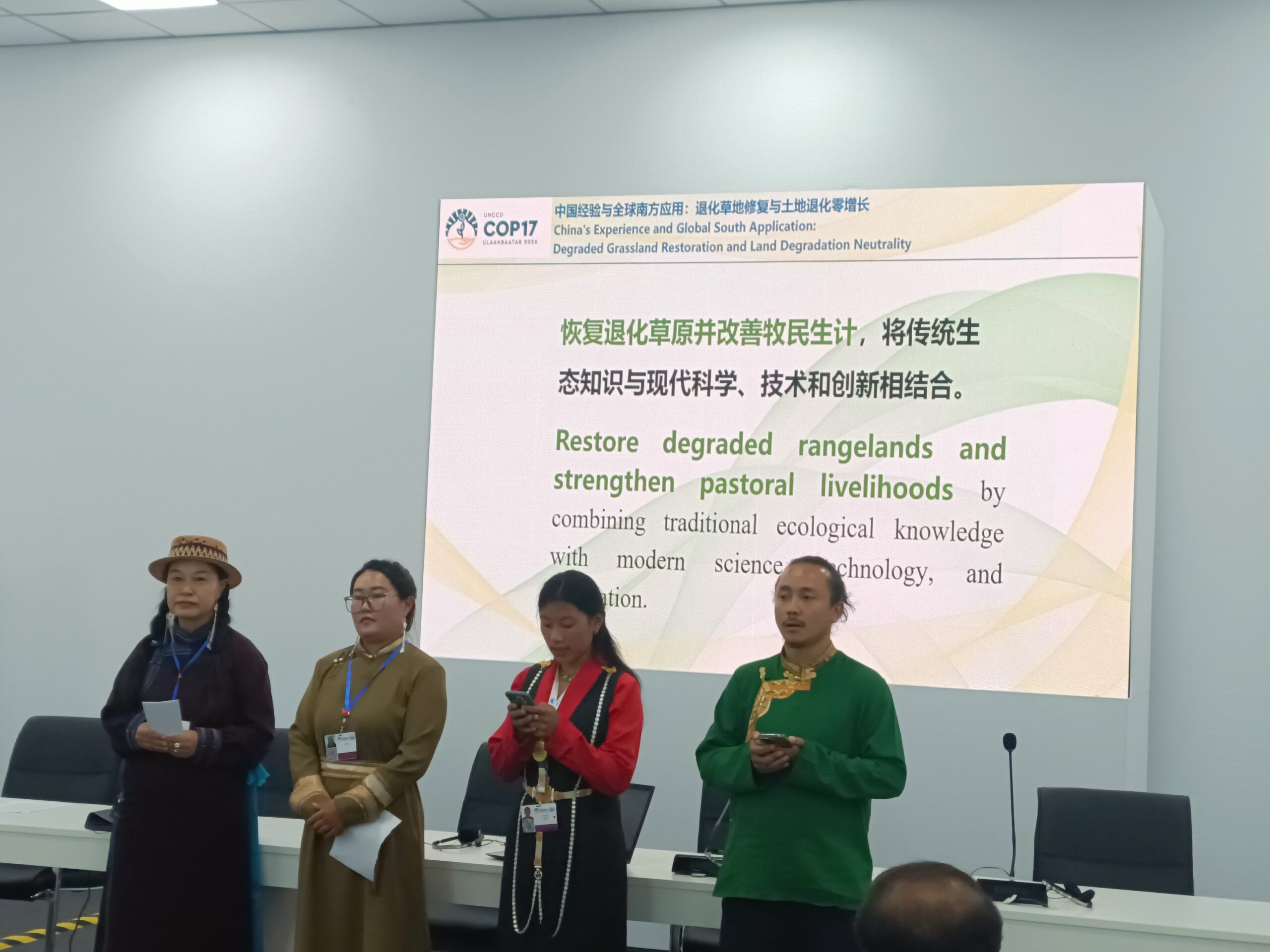
Four pastoralists from China, Africa, Nepal, and India read out the proposal to establish an International Rangeland Day in their own languages.
Representative from Inner Mongolia: Elevate grasslands to a global priority for biodiversity, climate resilience, land restoration, food and water security, and sustainable livelihoods.
Representative from Africa: Establish an International Grasslands Day under the UN to sustain global awareness, political commitment, cooperation, and action beyond 2026.
Representative from Nepal: Restore degraded grasslands and strengthen pastoral livelihoods by combining traditional ecological knowledge with modern science, technology, and innovation.
Representative from India: Mobilize investment and global partnerships to scale up grassland conservation, knowledge sharing, cross-border cooperation, and inclusive action by governments, communities, women and youth.
Extending the Momentum for Long-Term Action
From policymaking and scientific research to business practice and pastoral knowledge, the side event brought together the diverse actors needed to advance rangeland governance.
Participants stressed that the attention generated by IYRP 2026 should continue beyond the International Year, and highlighted the proposed International Rangeland Day as a possible long-term platform for policy dialogue, knowledge sharing and multi-stakeholder cooperation. They also called for stronger cooperation on rangeland conservation and restoration across the Global South, with the aim of turning the international attention generated during IYRP 2026 into sustained, long-term action.