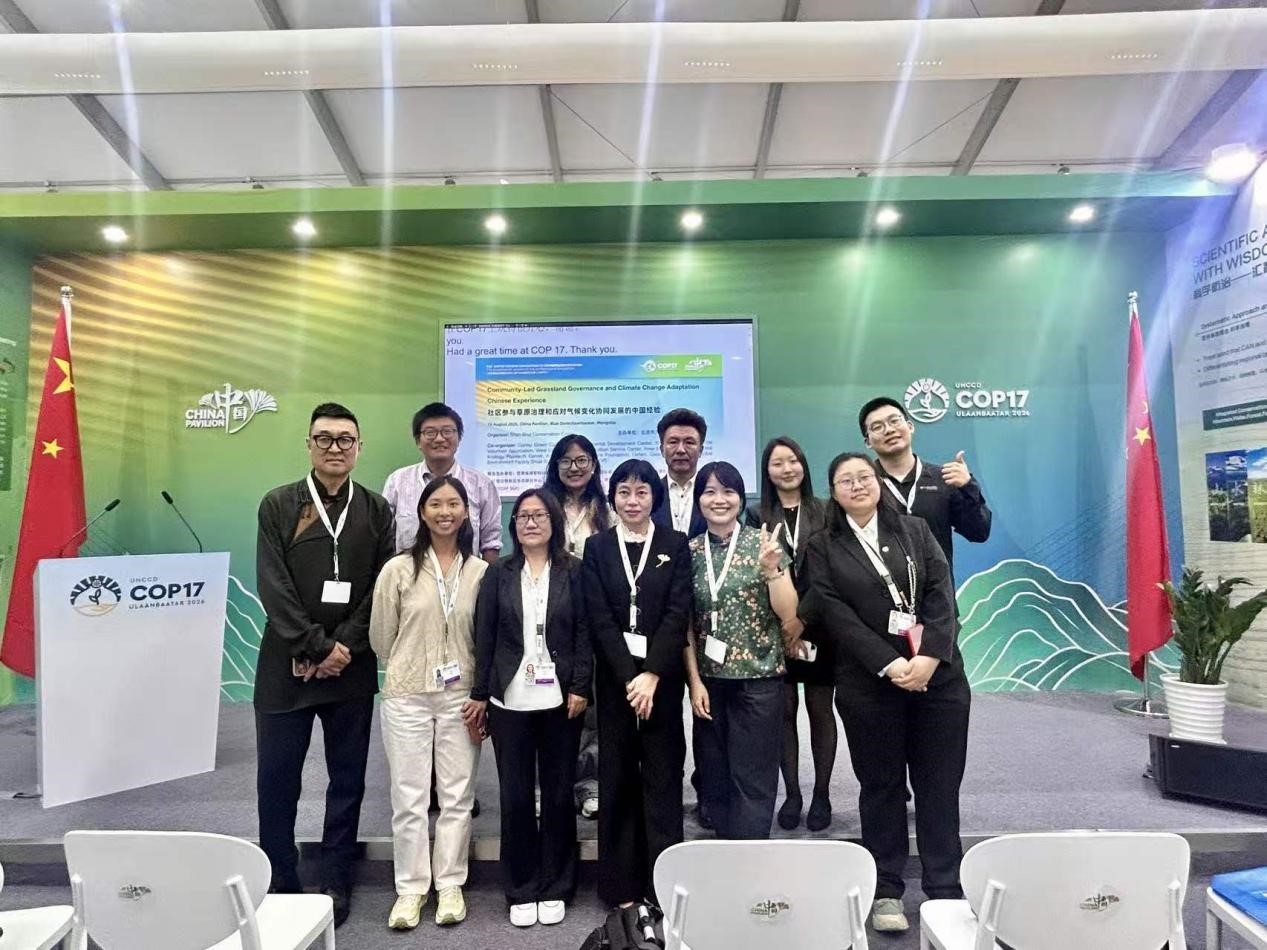
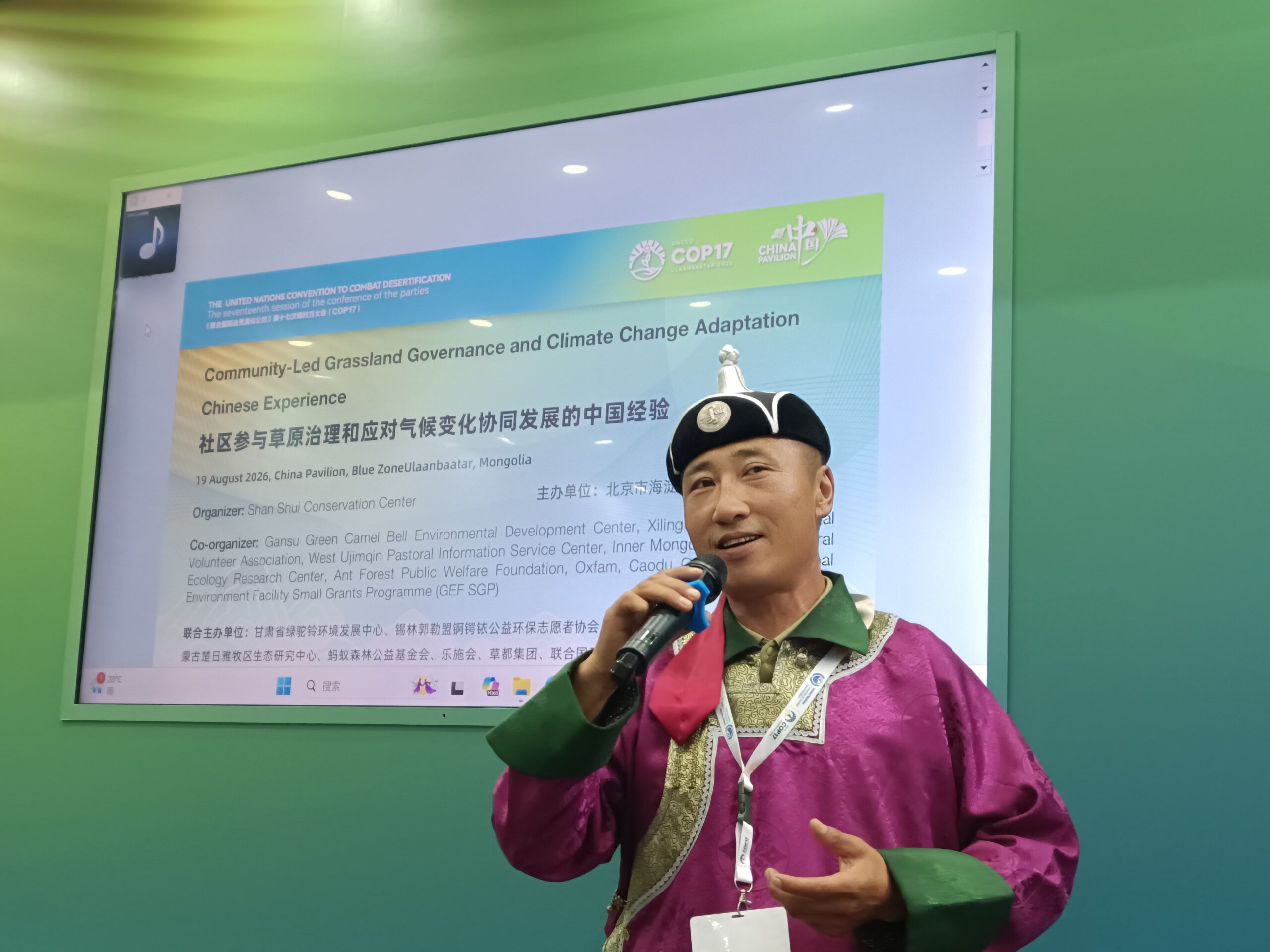
A side event themed “Chinese Experience in Collaborative Development of Community-Led Grassland Governance and Climate Change Adaptation” was held on August 19, 2026, at the China Pavilion in the Blue Zone of the UNCCD COP17 venue in Ulaanbaatar, Mongolia.
The event brought together experts, representatives of civil society organizations and community practitioners from China, Mongolia and international organizations to exchange experiences on community participation, grassland governance, climate change adaptation and sustainable livelihoods, and to explore community-led approaches to ecological governance in arid and semi-arid regions.
The side event was organized by the Shanshui Conservation Center, Haidian District, Beijing, with co-organizers including the Gansu Green Camel Bell Environmental Development Center, Xilingol AEI Environmental Volunteer Association, West Ujimqin Pastoral Information Service Center, Inner Mongolia Churiya Pastoral Ecology Research Center, Ant Forest Public Welfare Foundation, Oxfam, Caodu Group, and the UNDP Global Environment Facility Small Grants Programme (GEF SGP).
Making Communities a Driving Force in Ecological Governance
In her opening remarks, Liu Yi, Programme Management Specialist with the Environment and Energy Unit of the UNDP Asia-Pacific Regional Centre and GEF SGP Asia-Pacific Focal Point, noted that arid and semi-arid regions around the world are facing the dual challenges of land degradation and climate change.
As climate and ecological risks continue to intensify, strengthening the participation of local communities and Indigenous peoples in land governance and resilience building is becoming an increasingly important part of global environmental governance.
Shi Xiangying, Executive Director of the Shanshui Conservation Center, introduced China’s experience in developing community-based conservation areas in pastoral regions.
She noted that, against the backdrop of China’s continued efforts to advance ecological civilization and combat desertification, China has gradually developed a multi-stakeholder approach that combines government guidance, civil society participation and community- and herder-led action.
China has continued to strengthen grassland conservation through measures including the protection of basic grasslands, livestock carrying-capacity management, grazing bans and rest periods, and grassland ecological compensation programmes. These policies have provided an institutional foundation for community participation in grassland governance.
According to data shared at the event, relevant organizations have collected 117 cases of community-based conservation, including 22 pastoral community conservation areas, covering a total of 1.337 million hectares. Six of the cases have been assessed as broadly meeting the criteria for Other Effective Area-Based Conservation Measures (OECMs), with a combined conservation area of 109,000 hectares.
A wide range of community-led practices—including community co-management, self-governance and stewardship, sustainable grazing, degraded grassland restoration, species conservation, community-based monitoring and livelihood transition—are becoming an important part of grassland conservation in China.
China-Mongolia Dialogue: Finding Common Ground Across Different Governance Approaches
Grassland ecosystems transcend national borders. China’s Inner Mongolia and Mongolia share similar ecological conditions and pastoral traditions, while facing common challenges from climate change, grassland degradation and extreme weather.
Narangowa of the Inner Mongolia Churiya Pastoral Ecology Research Center presented a comparative perspective on grassland governance in China and Mongolia.
In China, grassland restoration has been supported primarily through national policies and ecological programmes, including grazing exclusion, grassland restoration and ecological compensation measures. Mongolia, meanwhile, has developed an approach combining policy regulation with community self-governance, with Pasture User Groups (PUGs) engaging in collective decision-making on pasture allocation and rotational grazing arrangements.
Despite differences in governance approaches, the two countries share a common ecological principle: mobility and adaptability.
From the flexible movement of traditional pastoral communities to dynamic monitoring and resource coordination in modern grassland management, the ability to adapt management practices to changing environmental conditions remains essential to building climate resilience in pastoral areas.
Participants suggested that China and Mongolia could further strengthen cooperation through cross-border joint monitoring, exchanges on ecological technologies, ecological conservation corridors and knowledge-sharing on traditional ecological practices, helping turn shared aspirations for transboundary grassland conservation into practical cooperation.
From Forage Banks to Community Co-management: Local Solutions for Climate Adaptation
Strengthening the climate resilience of pastoral communities in response to droughts, snow disasters, locust outbreaks and other extreme weather events was another major focus of the side event.
Bayar, Director of the West Ujimqin Pastoral Information Service Center, shared the experience of the forage bankin Bayan-Wundur Gacha.
Drawing on the participation of 117 herder households and 540,000 mu of grassland, the local community established a shareholding cooperative that combines forage reserves with community organization, financial services and ecological conservation. Forage is dynamically stored and rotated based on 10–15 percent of the livestock inventory.
During disasters, forage is supplied at prices 15–20 percent below market rates. The community has also explored mechanisms such as forage loans, forage exchanges and points-based incentives.
The forage bank is therefore more than a reserve of feed. It forms part of a broader community-based risk management system. Herder households gain more reliable access to forage, cooperatives strengthen their capacity to provide services, and governments and social organizations gain an additional mechanism for disaster preparedness and response. By reducing excessive grazing during disaster periods, the initiative also helps ease pressure on grassland ecosystems.
In Qinghai’s Sanjiangyuan region, communities are likewise playing an increasingly important role in ecological restoration and climate monitoring.
Wang Yiliao, Programme Coordinator at the Shanshui Conservation Center, introduced community conservation practices in Jiatang and Nianbaoyuze.
Local herders use community co-management committees to make decisions on grassland restoration areas and management approaches. Combining scientific species selection, enclosure-based restoration and locally developed techniques such as the use of cattle manure to support reseeding, communities have restored 150 hectares of degraded grassland, bringing high-quality vegetation back to areas once known as “black soil patches.”
Local herders have also taken on a new role as observers and recorders of ecological change.
Since 2004, herders have participated in glacier monitoring, evolving from marking locations with stones to using GPS positioning and photographic documentation. In 2025, they produced the documentary Snow Mountain Monitoring, using their own experiences to document changes in glaciers across the Qinghai-Tibet Plateau.
Turning Conservation into Livelihoods
Ecological conservation and community development do not have to be separate goals. Conservation can also create new livelihood opportunities.
In Jiatang, Qinghai, the Dengjialacuo Agricultural and Animal Husbandry Professional Cooperative has combined traditional felt-making techniques with contemporary design to develop a women-led handicraft industry inspired by wildlife and landscapes of the Qinghai-Tibet Plateau. Since its establishment in 2021, the cooperative has generated more than 280,000 yuan in revenue.
In the Hunshandake Sandy Land of Inner Mongolia, the Xilingol AEI Environmental Volunteer Association has explored an integrated conservation model linking grasslands, wetlands, sandy landscapes and migratory birds.
To address both the conservation needs of habitats for species such as the white-naped crane and red-crowned craneand the livelihood needs of local communities, the initiative has sought to transform herders from passive observers of conservation into active participants. Bird protection teams, nature education, ecotourism, homestays and cultural and creative products have helped build stronger links between ecological conservation and local economic development.
Among the community members contributing to these efforts are Hu Yulong, who has worked in ecological conservation for more than two decades; Wang Guobiao, who moved from being a hunting enthusiast to becoming a key member of a bird protection team; Yiboletu, who returned to his hometown to operate a grassland homestay while participating in migratory bird conservation; and Aonisu, who works in nature education for children.
Their experiences demonstrate that lasting conservation depends on enabling communities to move from being the “objects” of conservation to becoming active stewards, while ensuring that ecological value is translated into tangible benefits for local livelihoods.
The experience of the Maqu Grassland in Gansu Province further demonstrates the potential of integrating ecological conservation with clean energy and sustainable livelihoods.
Zhao Zhong, Director of the Gansu Green Camel Bell Environmental Development Center, introduced the organization’s work in promoting community-based natural resource management since 2005, alongside the development of ecotourism and environmentally friendly industries.
In the Ka’ersi community, income from ecotourism increased from 5,600 yuan in 2016 to 30,000 yuan in 2021. At the same time, distributed solar power has increasingly been used for electric cooking, heating, water pumping, electric fencing and livestock-product processing, providing pastoral communities in high-altitude areas with more accessible and low-carbon energy solutions.
From China’s Experience to Global Cooperation
Tugsbuyan Munkhbayar, representing the Mongolian Nature Heritage Foundation, introduced the “Eternal Mongolia” initiative and its approaches to community-based natural resource management and sustainable financing.
The initiative explores diversified financing mechanisms—including protected-area entrance fees, natural resource user fees, biodiversity credits and green loans—to provide long-term financial support for both conservation and community development.
The Mongolian Association for Environment and Development (JASIL) also shared two decades of experience with Community-Based Natural Resource Management (CBNRM) in Mongolia.
According to Ykhanbai Hijiaba, a representative of JASIL, the CBNRM approach places emphasis on multi-stakeholder coordination, bottom-up participation and learning through practice, with grassroots organizations such as Pasture User Groups (PUGs) and Forest User Groups (FUGs) playing a central role.
Mongolia currently has 1,509 CBNRM groups, covering approximately 81,600 herder households. Through pasture-use agreements with local governments, these groups participate in the management of approximately 30 million hectares of pastureland.
This bottom-up governance approach offers a useful complement to China’s more policy-driven model, providing valuable experience for cooperation on transboundary grassland governance.
From China’s policy-driven approach and community co-management to Mongolia’s community self-governance and Pasture User Groups; from forage banks and grassland restoration to glacier monitoring, bird protection teams and clean energy initiatives, the experiences shared at the side event differed in their approaches but pointed to a common conclusion:
The resilience of ecological governance ultimately depends on the participation, knowledge and action of local communities.
Pastoral communities and herders are key actors in grassland governance and should receive greater recognition, support and opportunities to participate. China’s experience in combining policy guidance, community-based governance, technological innovation and the preservation of traditional knowledge offers useful lessons for community-based ecological governance in dryland and semi-arid regions around the world.
From a single pasture and a community forage bank to bird protection teams and local glacier monitors, the foundations of ecological governance are being built within communities. Through exchanges across regions and borders, these local efforts can contribute to a broader collective response to global environmental challenges.
Looking ahead, participants will continue to promote the exchange and sharing of community-based experiences, support pastoral communities in strengthening climate resilience, and explore greater synergies among biodiversity conservation, improved livelihoods and climate action—working together toward a more resilient future in which people and nature thrive together.