

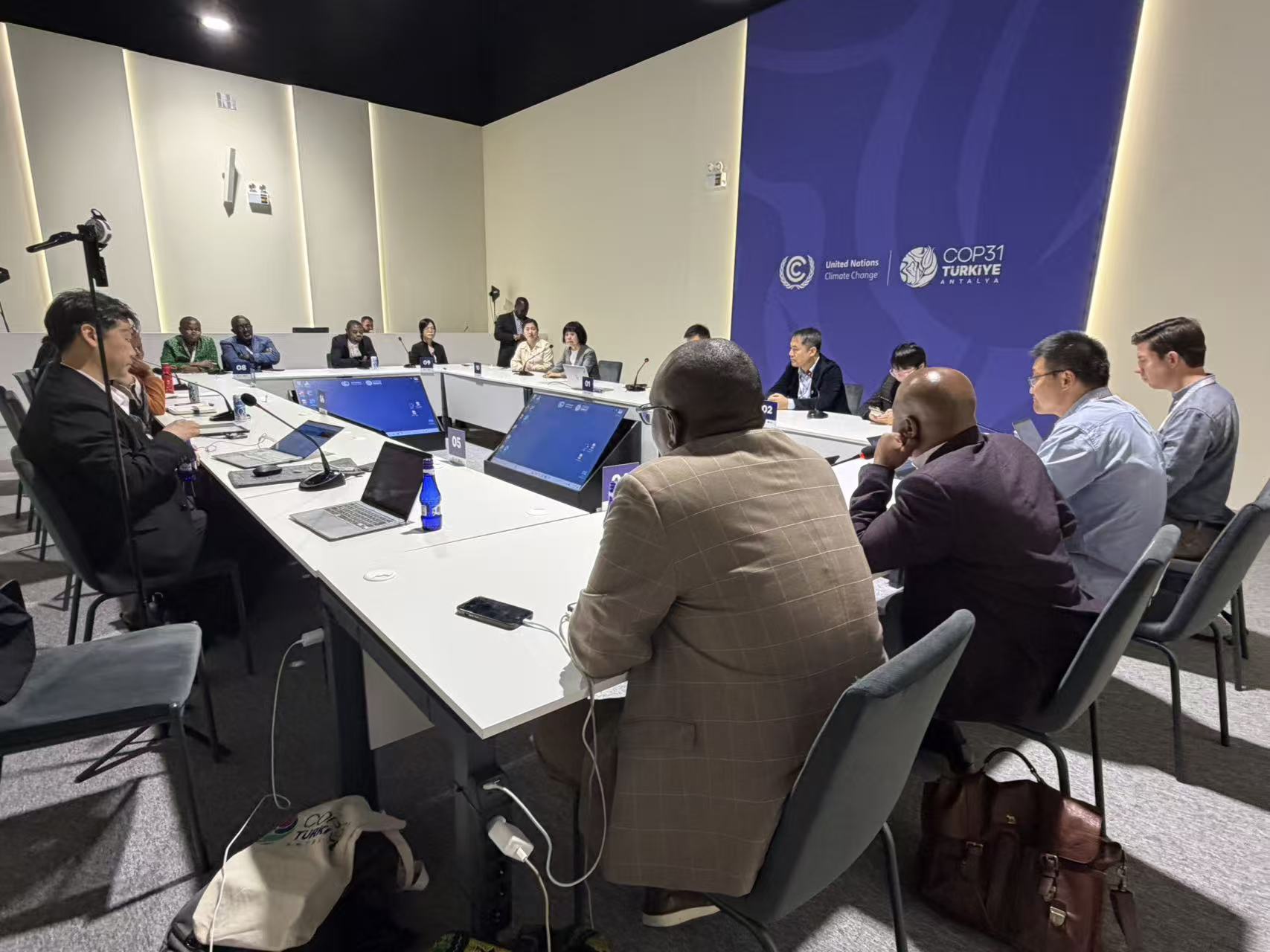
Antalya, 14 November. At COP31, a dialogue between civil society organizations, Chinese industry associations and academic institutions was held in the Blue Zone. It was co-hosted by Green Camel Bell and Southern Africa Resource Watch (SARW). Participants included representatives of the China Investment Association, a Hangzhou renewable energy industry organization, universities and companies, together with civil society groups from Africa. They discussed the impact of Chinese mining investment, local value addition and responsible mining.
 African voices: where does the value stay, and what do communities get?
SARW said Chinese companies are now major players in Africa’s mining and other key sectors, and that communities want to understand how companies operate and how impacts can be reduced. SARW Senior Advisor Davie Malungisa noted that about 90% of global critical mineral processing takes place in China, and asked whether Chinese industry associations are prepared to move parts of the value chain to Africa. He presented the continental blueprint One Voice, One Strategy. A civil society representative from Uganda raised the East African Crude Oil Pipeline. She said it runs 1,443 km, has displaced tens of thousands of people in Uganda and Tanzania, and affects forests and protected areas, and that it is hard to engage the Chinese parties involved.
 Industry response: “bilateral industrial parks” and local processing
A representative of the China Investment Association’s energy investment committee described a “two countries, two parks” model, in which a zero-carbon industrial park is built in a partner country while that country builds one in China. He said the largest project so far is the China–Mongolia park, and that an MOU has been signed with the Zambia Development Agency. He acknowledged that simply buying raw ore is no longer workable, since many African countries have restricted raw ore exports. He said China is gradually opening up some processing steps, and that downstream copper processing such as cables could eventually move to Africa. The main obstacles, he said, are weak infrastructure (water, power, heat, gas) and high financing costs, with interest rates above 20% in some countries. The association has set up a financing platform in Hong Kong and plans to invest in park infrastructure.
 Clean energy for mines: technically feasible, and socially feasible too
A representative of a Hangzhou renewable energy industry organization said solar plus storage can cost about 60% less than diesel at remote mine sites. He also flagged open questions on land use, community benefits, operation and maintenance, and what happens to the assets when the mine closes. He said the goal is solutions that are environmentally friendly, technically feasible and socially responsible. Civil society speakers from South Africa shared a community-ownership model for renewable energy in Limpopo. SARW said it plans to discuss with Chinese mining companies in places like Zambia whether supplying energy to communities can be part of their social investment.
 Academic responses
One scholar warned of the “resource curse”, climate risks and carbon border measures, and called for China–Africa cooperation on energy-industry integration, shared climate risk and carbon data capacity. An associate professor from a Los Angeles university suggested learning from China’s rural electrification and starting with small, bankable community projects. A Chinese lawyer noted that company counsel typically treat legal compliance as the baseline, which is why dialogue between business and civil society matters.
 Next steps. Participants called for more exchange between Chinese and African civil society groups to reduce misunderstandings. SARW proposed engaging African industry associations too, and said it wants to study cases such as the China–Mongolia parks and visit China. Contact details were exchanged and the dialogue will continue.