

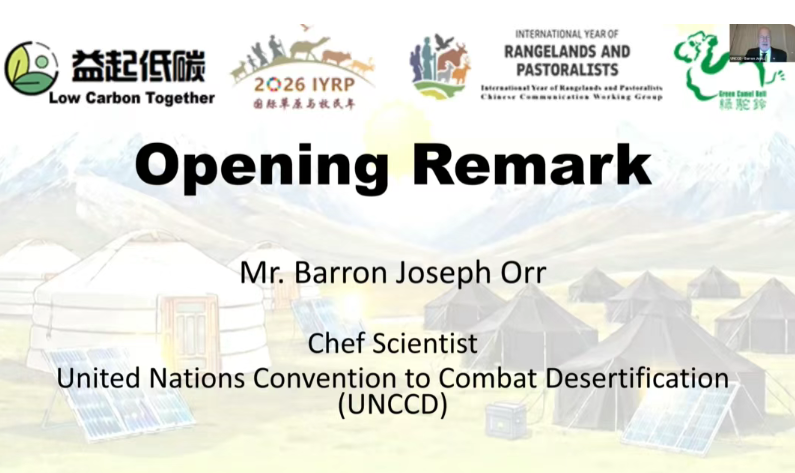
Director Zhong Zhao, colleagues and friends, it is a pleasure to join you today.
I warmly thank Green Camel Bell and partners for this kind invitation, and for your leadership in bringing together pastoralist voices, renewable energy innovators, and rangeland scientists in the International Year of Rangelands and Pastoralists (IYRP). Your work using distributed solar to reduce reliance on diesel and coal, improve energy access, and empower nomadic herders to engage with the Sustainable Development Goals is precisely the type of locally driven innovation the UNCCD seeks to elevate.
On the 17th of August later this year, the 17th session of the UNCCD Conference of the Parties, or COP17, will take place not far from you in Ulaanbaatar, Mongolia. Parties will build on recent decisions that formally bring rangelands and pastoralism into the heart of the Convention’s mandate and call for greater synergy between land, climate and biodiversity goals.
Rangelands now account for more than half of the Earth’s land surface and around 70 per cent of agricultural land, yet they are among the most overlooked and rapidly degrading ecosystems, with rangeland degradation threatening about one sixth of global food supply and one third of terrestrial carbon stocks.
Aligning pastoralist energy access with COP17 outcomes therefore means using renewable energy not only to cut emissions, but to avoid, reduce and reverse land degradation in line with the Land Degradation Neutrality (LDN) response hierarchy.
The recently published IISD report “A Natural Fit” focused on renewables and sustainable land management shows that, on average, solar PV has a higher land-use intensity than fossil fuel generation, but that most of the land within solar arrays can remain available for grazing or vegetation if projects are designed as true dual-use systems. The fact that renewable energy systems are inherently scalable can be an economic boon, while posing serious environmental and social risks without responsible governance. But their land footprint can be turned from a liability into an asset when countries apply LDN, optimizing the “where” of projects relative to underlying environmental constraints and safeguarding the tenure rights of current land users.
Agrivoltaic and “rangevoltaic” approaches—co-locating PV with crops or livestock—can increase total land productivity by 35–70 per cent compared to single-use systems, mainly by reducing heat and water stress and improving yields or animal welfare.
A China case highlighted in the IISD report: A 200-megawatt agrivoltaic project on severely eroded land increased vegetation cover from about 1 per cent to 90 per cent, improved soil moisture and fertility, and now supports high-value understory crops and local employment, while supplying grid power equivalent to the needs of 100,000 households.
Another recent report published by IRENA–CREEI–IUCN on local environmental impacts of large-scale solar PV reinforces three lessons that are highly relevant for pastoralist landscapes.
First, when siting follows the LDN response hierarchy—avoiding key biodiversity areas and high-value rangeland, minimising land clearance, and restoring vegetation—solar plants need not compete with agriculture and can be preferentially placed on degraded or marginal lands, mine sites, and existing infrastructure.
Second, in arid and semi-arid settings, careful design of panel height, spacing and orientation can use microclimate effects—shade, reduced wind speed and lower evaporation—to aid vegetation recovery and even help control sand and dust storms.
Third, integrating solar with grazing (“solar grazing”) can lower fire risk, cut vegetation management costs, and increase meat or milk production, provided herders’ access and mobility are safeguarded.
From a COP17 perspective, distributed solar for pastoralists becomes a lever for three priority shifts.
First, it can avoid further degradation by reducing dependence on fuelwood and dung, easing pressure on fragile shrubs and soils.
Second, it can reduce ongoing degradation by powering solar water pumps, cold chains and local processing—improving water management, lowering post-harvest losses and increasing land-use efficiency in pastoralist agri-food systems.
Third, it can reverse degradation where agrivoltaic or ecovoltaic projects are explicitly designed as rangeland restoration investments, embedded in integrated land-use planning and backed by secure tenure and fair benefit-sharing for pastoralist communities.
Green Camel Bell’s experience—combining solar home systems, pastoralist cooperatives, and grassland stewardship—offers exactly the kind of evidence COP17 needs to see. I hope this webinar will help us distil concrete principles on nature-positive and pastoralist-positive siting, dual-use design, rights-based governance and financing for productive uses of renewable energy, so that pastoralist energy access becomes a frontline contribution to “Restoring Land, Restoring Hope” in rangelands worldwide.
“Restoring Land, Restoring Hope” is the theme Mongolia has embraced for COP17, and it is my hope you will all join us in Ulaanbaatar, Mongolia in August!
Today, I wish you all a successful webinar and progress in the important work you are all doing.
Thank you